
Chipped or Knocked Out? Wilmington Emergency Dental Care
Your kid trips on the playground. You bite into something wrong. Suddenly there’s blood, a loose tooth, or a tooth in your hand, and your brain goes straight to worst-case scenario. Do you rush to the ER? Call an emergency dental care dentist? Wait until morning? Here’s the good news: most dental injuries follow a simple triage plan.
A fully knocked-out permanent tooth is a minutes-matter problem. Put it back in the socket if you can, or store it in milk or saliva, and get help immediately. A small, painless chip often is not. Knowing the difference can save a tooth and save you an unnecessary trip to the emergency room.
In this post, we’ll sort injuries into three buckets: same-day, next-morning, and watch it. You’ll learn the first-aid sequence for a knocked-out permanent tooth, when to choose the ER instead of the dentist, how baby teeth and permanent teeth differ, what emergency dental care costs and how we make it easier, and how to prepare before you need it. Let’s stop guessing and start triaging.
Why Triaging a Dental Injury Beats Panicking
Traumatic dental injuries are common, and almost never your fault. Twenty-five percent of all school children experience dental trauma, and roughly a third of adults have injured a permanent tooth, most before age 19 (IADT combined guidelines). A meta-analysis also found a world prevalence of 22.7% for traumatic dental injuries in primary teeth. Dental injuries comprise about 5% of all injuries. Guilt and panic both slow you down, so it helps to say that out loud.
Our emergency dental care team sees them regularly in Wilmington, and we are not judging how it happened.
The real question in the first ten minutes is not “how bad is this?” It is “which of three buckets am I in?” Once that is clear, your next step is obvious.
Avulsion, a permanent tooth knocked completely out of the socket, is just 0.5% to 16% of dental injuries, but it is the one where the first few minutes shape the outcome (AAPD/IADT avulsion guideline).
Glossary: avulsion (tooth completely out of the socket), fracture (a crack or break), luxation (tooth loose or shifted but still in the socket), pulp (the nerve and blood vessel tissue inside), enamel (the hard outer shell).
None of this is a diagnosis. Use it to decide whether to call, then let us examine you for advice that fits.
The Three Buckets: Same-Day, Next-Morning, Watch It
Here is how they sort: same-day covers the urgent cases, next-morning covers problems that can wait overnight, and watch-it covers minor changes worth noting but not acting on immediately. The sections below cover each bucket in detail, skip to whichever fits.
Ask two questions: does it hurt when you bite down, and does the tooth move when you touch it? Pain on biting plus movement suggests a root or bone injury, so it climbs the list.
Unsure? Call 302-239-0410 and describe what you see; a two-minute call beats guessing. We keep early and evening hours, Monday and Tuesday until 8 p.m. and Friday from 7 a.m., so the next-morning bucket has a place to land. You can also book online. Financing and estimates keep cost manageable.
Bucket 1: Same-Day Emergency Dental Care
If any of these fit what you are seeing, you belong in Bucket 1. Call us at 302-239-0410.
- Knocked out permanent tooth: the minutes matter case. Handle it by the crown, the part you normally see, never by the root, and get it to us fast. The full sequence is in its own section below.
- Tooth pushed out of position (luxation): still in the socket, but shifted. It may look shorter or longer than its neighbor and often bleeds at the gumline. Do not push it back yourself. Call us today.
- Broken tooth with a red dot or bleeding from the center: that spot is the pulp, the nerve tissue inside the tooth. It reacts sharply to air and temperature, and it needs same-day care. Clinicians call this a complicated crown fracture.
- Severe or steadily worsening pain: especially pain that keeps you awake at night and does not ease with over-the-counter pain relief used as directed on the label.
- A tooth that is loose or tender when you bite, or a section of gum and bone that moves along with it. That pattern suggests an alveolar fracture, meaning the bone holding the tooth has broken, so it needs prompt attention.
- A blow to the mouth with bleeding you cannot bring under control with steady pressure.
Bucket 2: The Next-Morning List
This bucket is for problems that rarely worsen overnight.
A visible crack or chip qualifies if there is no red spot, no bleeding from the center, and no looseness. A lost filling or crown that causes only mild sensitivity can usually wait for a morning call; bring any loose piece with you. Sensitivity to cold or sweets that settles also belongs here, with no swelling, fever, or bad taste. So does a bruised or slightly discolored tooth after a knock, with no looseness and no pain on biting. Color change can appear days later, so it is worth a look even if today feels fine.
Why morning and not whenever? Small fractures and lost restorations rarely become emergencies overnight, but delay lets the tooth crack further or the nerve get irritated. A morning visit also lets us take proper imaging. Our office opens at 7 a.m. Fridays and stays until 8 p.m. Mondays and Tuesdays.
Tonight, keep the area clean, avoid chewing on that side, and take over-the-counter pain relief only as directed on the label. If swelling, fever, or spreading pain starts, move up to Bucket 1 or read the emergency room section below.
Bucket 3: The Watch-It List
Here is what belongs in Bucket 3.
A small chip in the enamel, the hard outer shell, that you cannot feel with your tongue, does not hurt, and shows no pink or red underneath. These are common on front teeth and often need only smoothing or a simple bonded repair at a regular visit. A chipped back tooth edge fits here too, as long as it is not sharp enough to cut your tongue or cheek.
A tooth that feels different after a bump but is not loose, not tender when you bite, and not discolored can also wait. Mention it at your next scheduled cleaning if nothing changes.
If the edge is catching on your cheek or tongue, move it to Bucket 2 and call us.
Watch it does not mean ignore it. Note the date it happened and mention it at your next exam. A quick look at a chip is part of the exam we do anyway.
What moves it out? New pain, new looseness, new swelling, a color change, or a chip that gets bigger. Any one of those, call us.
Knocked Out Permanent Tooth: The First-Aid Sequence
The one true minutes-matter injury is a permanent tooth knocked completely out of the socket, called an avulsion.
Step 1: Stay calm and find the tooth. Pick it up by the crown, the white part you normally see. Do not touch the root, scrub it, or soak it in water.
Step 2: If it is dirty, rinse it briefly with milk, saline, or the person’s own saliva. Handle it gently; seconds count.
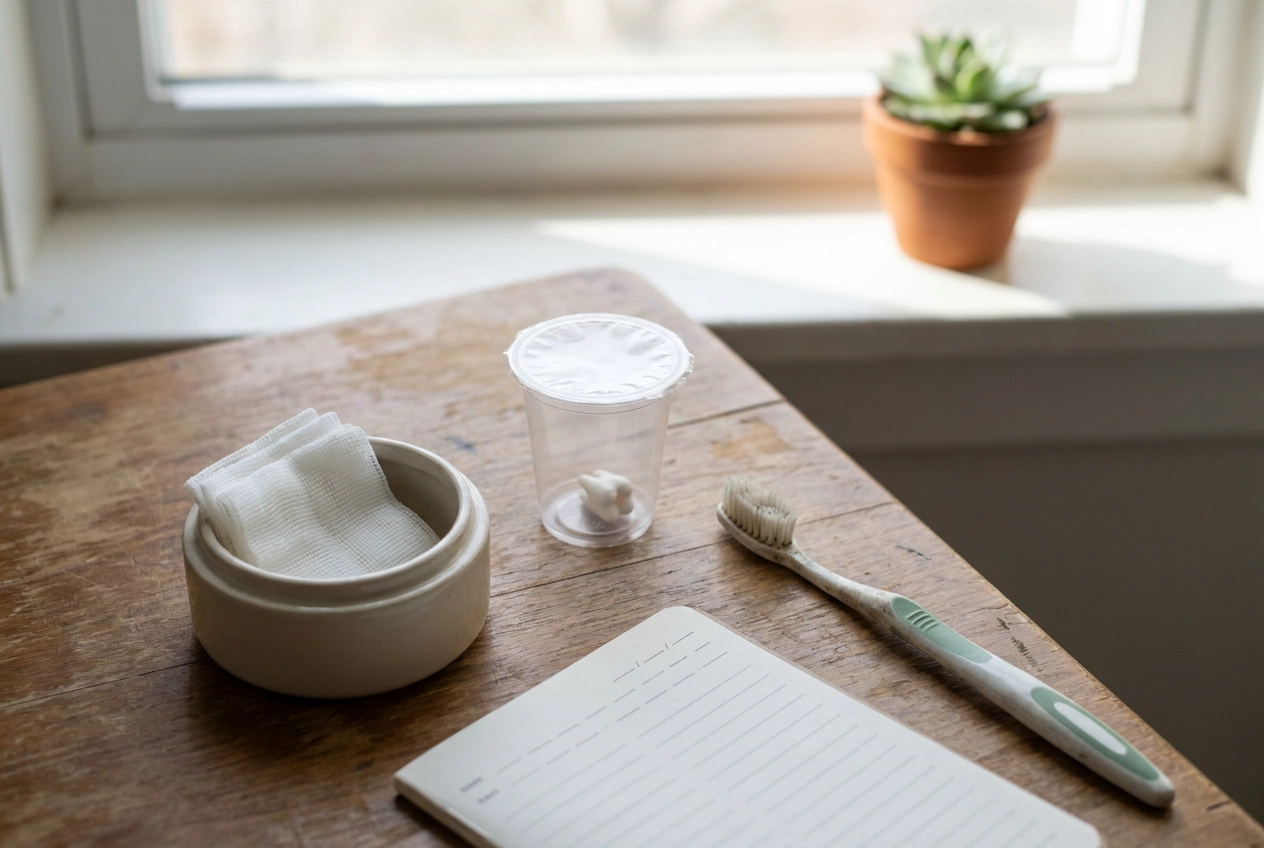
Step 3: If you can, put it back in the socket and have the person bite gently on clean gauze. If not, store it in a small container of milk or their own saliva. Do not let it dry out, and never use water.
Step 4: Call our Wilmington office right away at 302-239-0410. If we are closed, go to the nearest emergency department and bring the tooth in its container, even if it looks hopeless.
Step 5: A knocked-out baby tooth is different. Do not put it back in the socket, the approach for baby teeth differs from permanent teeth in important ways; call us and we will guide you.
Why the rush? The guideline is clear that outcomes after avulsion depend heavily on what happens at the place of the accident, which is why first-aid awareness is so strongly encouraged (IADT). No result is guaranteed. Get the tooth to a dentist quickly so we can examine it, take imaging, and talk through your realistic options.
When It Is the Emergency Room, Not the Dentist
A knocked-out tooth with no other injuries is ours to handle. Call us first at 302-239-0410. An emergency room can see you, but the tooth still needs a dentist, so you may wind up making two trips instead of one.
Some problems belong at the hospital. Go to the emergency room, not our office, if there is facial swelling with fever, or any trouble breathing or swallowing. Those signs can point to an infection that needs hospital-level care.
Other reasons to go straight to the emergency room include uncontrolled bleeding, a suspected jaw fracture, any head injury, loss of consciousness, or a wound that may need stitches, these go beyond what a dental office handles. A dentist emergency service handles teeth, gums, and the supporting bone, not airway, breathing, or head injury. If you are unsure which situation you are in, err toward the ER and call us afterward.
If we are closed, call anyway and leave your name, number, and what happened. Our team will call back with the next step. One detail speeds things up: whether it was a baby tooth or a permanent one.
Baby Teeth vs. Permanent Teeth: Different Rules, Different Stakes
Next question: whose tooth are we talking about? Baby teeth and permanent teeth follow different rules.
A knocked-out baby tooth is handled differently from a permanent tooth, do not attempt to reinsert it. Call us for guidance on next steps.
Loose or shifted baby teeth are common, because the root shrinks as the permanent tooth arrives. Luxation injuries, where the tooth shifts but stays in the socket, are among the more common baby-tooth injuries we see. Kids repeat injuries often, especially toddlers and early grade schoolers. That’s a reason to save our number now, not to feel bad about a fall.
Small enamel chips in baby teeth usually just need a look, maybe a smoothing. A chip with a red or bleeding center, or a tooth that turns gray or hurts, needs to be seen.
Permanent teeth still growing get extra care: we work to keep the pulp, the nerve and blood supply inside, alive so the root can finish forming. That’s another reason not to wait on a young person’s broken tooth.
When you call, tell us everything: how it happened, when, any loss of consciousness, and whether a tetanus shot is current. Those details change how we plan your visit.
What Emergency Dental Care Costs, and How We Make It Easier
Whatever your exam turns up, you will know the cost before we start. Fees depend on the treatment and your specific plan, so we do not quote prices in an article. We give you an estimate first, so nothing surprises you.
We are in-network with most major plans and will walk you through your coverage. Have your card or member ID handy when you call.
CareCredit and Cherry financing are available if you would rather spread a larger treatment over time. Ask when you call and we will explain.
Most injury care happens in one office: exams, imaging, fillings, crowns, root canals, dental implants, bonding, and cosmetic repair. Our CBCT 3D imaging shows root and bone injuries clearly, and we use the Waterlase laser and DIAGNOdent where they help.
If dental visits make you anxious, say so. Dr. Myochul Kwon, Dr. Nick Faure, Dr. Whitney Kehrer, and Dr. Suraj Patel take time to explain what they see. We are a family practice on Limestone Road, not high-volume, with more than 45 years caring for local families.
Next Step: Save This Number Before You Need It
For a quick reminder: a knocked-out permanent tooth is always call-now; a broken tooth with an exposed centre, a loose tooth, or severe pain is same-day; a small painless chip or a lost filling with no swelling can usually wait until morning; and facial swelling with fever or trouble breathing means the ER.
Call Pike Creek Dental at 302-239-0410, or book an appointment. We care for families in Pike Creek, Wilmington, Hockessin, Newark, Greenville, and nearby Landenberg, PA.
Our contact page lists hours and directions. Send a message and you’ll reach a thank-you page confirming it arrived; appointment requests end on a confirmation page with next steps.
Save 302-239-0410 in your phone today. The best time to have your dentist’s number is before you need it.
Conclusion
Dental injuries feel frightening, but a calm triage plan makes the next step clear. Call Pike Creek Dental at 302-239-0410 or book online. Save the number now, before you need it. Protecting a smile starts with knowing exactly who to call.








Leave a Reply