

Missing Tooth? Compare Bridges, Dentures and Implants
A missing tooth is not just a gap in your smile. It is a daily question: what do I do now? If you are weighing a replacement tooth, you have likely heard about bridges, dentures, and implants. Each path has real trade-offs, and the right choice depends on which teeth are missing and what you are realistically willing to maintain.
This guide compares all three side by side instead of pushing one option. We will start with the three ways to replace a missing tooth in plain terms. Then we will look at the teeth next door, bone preservation in your jaw, daily upkeep, and time in the dentist’s chair. You will also learn how to read longevity numbers carefully, compare costs and insurance fairly, and see why the location of the missing tooth changes the answer. We will finish with a simple decision framework, where implants and crowns fit in, what an exam adds, and your next step toward replacing that tooth.
Three Ways to Replace a Missing Tooth, in Plain Terms
“Replacement tooth” can mean three very different experiences and three very different commitments.
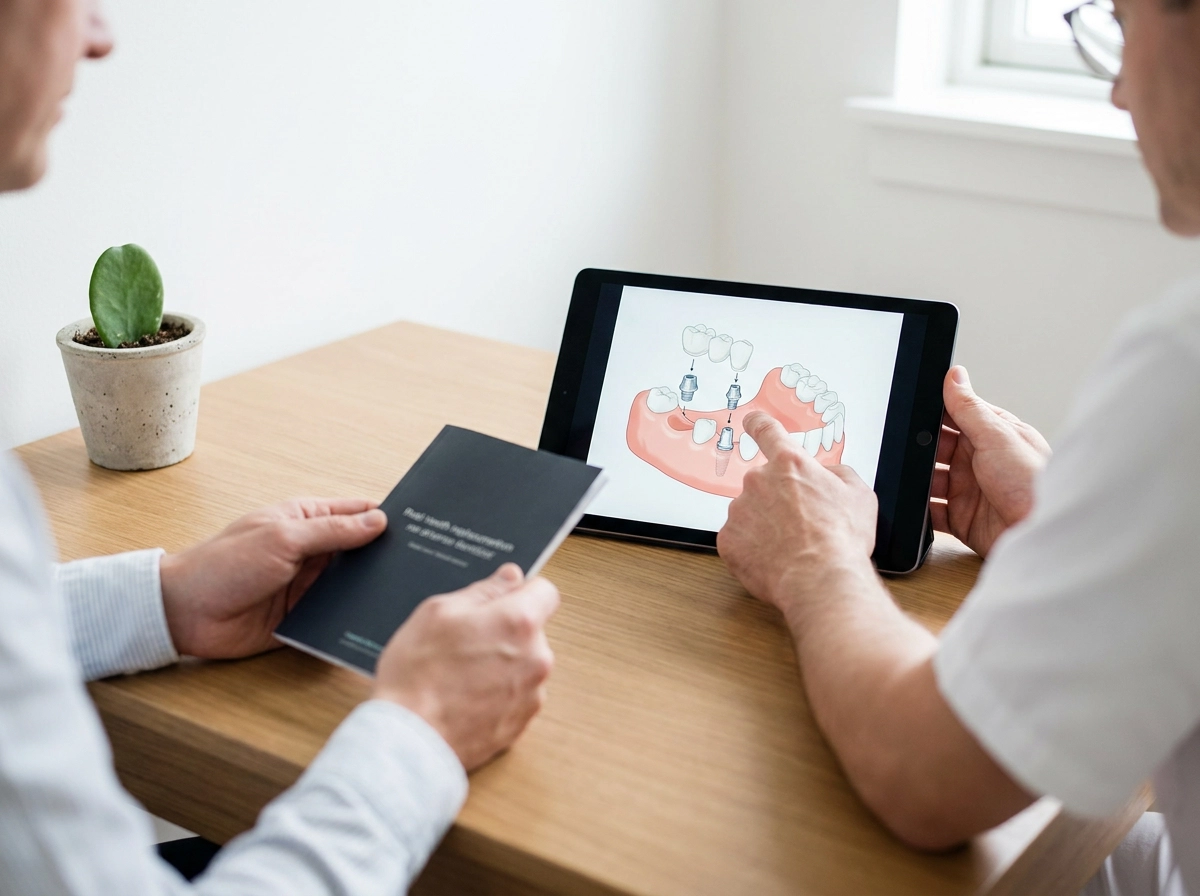
A bridge is a fixed row of crowns cemented onto the teeth on either side of the gap, so the missing tooth is held in place by its neighbors.
A denture is removable. A partial denture fills part of an arch; a full denture replaces all teeth in an arch. Both are removable.
An implant is a small post placed in the jawbone and topped with a crown. Nothing attaches to the neighboring teeth.
Notice that “crown” appears in all three conversations. That is why so many people search for dental implants and crowns together, even while still comparing options.
Crowns, bridges and implant restorations all fall under restorative dentistry, and if the gap is near the front, appearance matters too, so cosmetic dentistry often joins the plan.
Next, let’s look at what each option asks of the teeth next door.
Trade-Off 1: What Happens to the Teeth Next Door
Now the part that surprises people most: a bridge is rarely a solo project. A traditional bridge holds the replacement tooth in place with crowns that fit over the natural teeth on either side of the gap. Those neighbors are often perfectly healthy, which is the hardest part for patients to hear.
An implant leaves them completely untouched, which matters a great deal if those teeth have never had a filling or a crown.
A partial denture rests on and engages nearby teeth to stay in place.
Some bridges use a resin-bonded design that preserves more tooth structure; your dentist will assess whether that design suits your bite.
So ask which teeth you would be committing for the long term, not just which option looks best in a photo of a finished smile.
Trade-Off 2: Bone Preservation and Your Jaw Over Time
Then there’s the bone itself.
After a tooth is lost, bone changes can occur in that area. Dentists call this resorption. It’s expected, not a sign you did something wrong.
Options differ in how they interact with the bone beneath the gap; your dentist can explain what imaging shows about your ridge before recommending a path. Ridge changes over time can affect how a denture fits.
Bone quality also decides whether an implant is possible. That’s why the dental implant process here starts with a three dimensional scan, called CBCT, at our Wilmington office rather than a two dimensional X-ray.
Trade-Off 3: Daily Upkeep and Long-Term Maintenance
Upkeep matters.
Bridges: Clean under the bridge daily with a floss threader or interdental brush. The supporting teeth still get decay and gum disease like any other tooth.
Dentures: Daily cleaning is essential, as is returning for periodic adjustments as your mouth changes.
Implants: Clean around the crown and gum line like a natural tooth, and keep your hygiene visits. The crown can still wear, chip or loosen. Older evidence, labeled as historical: a 2000 systematic review reported roughly 83% of implant crowns stayed free of complications at four years. The authors called crown complications common, worth knowing before assuming the implant ends the story.
Whatever you choose, gum health drives longevity. Our Total Health Dentistry approach treats gum inflammation as part of whole body health, not a separate chore. If budgeting for upkeep feels tight, see how Pike Creek Dental patients keep care affordable when insurance costs rise.
Trade-Off 4: Time in the Chair and Number of Visits
Upkeep is one kind of commitment; time is another. A bridge typically requires fewer visits than an implant; a denture involves multiple fittings and adjustments. An implant is the longest path, placement, healing and crown placement are separate stages.
The right sequence depends on your situation.
Ask how many visits you can realistically attend around work, travel or caregiving. We keep early and evening hours on Monday and Tuesday and open at 7am Friday to make that easier.
Next, we will look at longevity and why those numbers need careful reading.
What We Know About Longevity, and Why the Numbers Need Careful Reading
Time in the chair matters, but so does how long the work lasts, and the percentages you see online deserve a second look.
Older dental literature put bridgework for a single missing tooth at roughly 75% survival after 15 years, a figure the same 2000 review borrowed from earlier sources rather than fresh data.
The same 2000 review’s implant survival data, noted in the upkeep section above, tells only part of the story, four-year outcomes for implants differ substantially from fifteen-year outcomes for bridges.
Read those side by side and you might crown a winner. Don’t. One covers four years, the other fifteen, and they come from different studies. Short term versus long term is the honest framing.
That review’s evidence window closed in 1998. Implant surfaces, CBCT planning and digital scanning have all changed since. Ask us what to expect today rather than trusting a 25 year old number.
Cost, Insurance and Financing: How to Compare Fairly
The same caution applies to price. What you pay depends on the treatment and your specific dental plan, so anyone quoting one flat number for all three options is oversimplifying your situation.
Upfront costs and long-term costs differ for each option; plan design, not a single flat price, governs what you actually pay.
We are in network with most major dental insurance plans, and we give you an estimate before treatment starts, so there are no surprises on the day.
If spreading payments over time makes the decision easier to make now rather than later, CareCredit and Cherry financing are available.
Cost is one column of this comparison, not the whole spreadsheet.
Which Teeth Are Missing? Why Location Changes the Answer
Now that the cost picture is clearer, here is the question that quietly decides more than any price tag: where is the gap?
Front teeth are highly visible and affect speech, so aesthetics and shade matching take on more weight. Back teeth bear heavy chewing load, which influences whether something fixed is preferred. Several teeth missing in a row? A bridge or partial denture can cover that span efficiently, sometimes with fewer implants than one per tooth. If most teeth in an arch are gone, a full denture or an implant-supported option often makes more sense than patching one gap at a time. The condition of neighboring teeth is also a genuine clinical consideration our doctors weigh when recommending a path forward.
What Are You Realistically Willing to Maintain?
Location narrows the list; your daily habits decide which option actually lasts.
A denture that spends its evenings in a drawer is not solving anything. A bridge needs cleaning under it every day, no skipping. The implant path asks more of your calendar and your patience, with appointments spread across months of healing. Flossing under a bridge or around nearby teeth takes steady hands and decent light. A floss threader helps, but it takes practice.
Your health history, including smoking, uncontrolled diabetes and active gum disease, shapes which option is realistic and how healing goes.
Worried about the dentist? Anxious patients do well in our Wilmington office. Our doctors explain each step before it happens, and you set the pace, whether you visit us from Pike Creek, Hockessin, Newark or Greenville.
Bring that honesty to your exam, and the decision gets much simpler.
A Simple Decision Framework: Matching Options to Situations
Once you know what you’re willing to maintain, the choice often sorts itself out. Most situations land in one of these buckets:
- One gap, healthy neighbors: an implant avoids touching those neighbors, which is often the strongest argument in its favor.
- Neighbors already heavily restored, or you want fewer visits and a fixed result: a bridge can be a sensible, predictable choice.
- Several missing teeth, a limited budget, or a medical reason surgery isn’t wise: a partial or full denture may serve you well for years.
- Bone too thin in the gap: grafting may be discussed, or a bridge or denture becomes the more practical route.
- Mixed cases: a bridge on one side and an implant on the other is a normal plan, not a compromise.
There’s no single right answer. If an implant is on your list, it helps to understand its two parts.
Dental Implants and Crowns: Where They Fit in This Comparison
Once you have a rough sense of which option fits your situation, here is the part of the implant path patients ask about most.
The implant post is placed in the bone; a crown is then cemented or screwed on top. Crowns for dental implants are shaped and shaded to match your other teeth. That crown is the part you see and chew with, and over years of use it can wear, chip or need replacing.
Planning uses 3Shape TRIOS digital scanning and 3D imaging, so we can show you the intended position before treatment begins.
Which is why an implant is not simply a replacement tooth. It is a system, with a maintenance schedule attached.
What an Exam Adds That an Article Cannot
That maintenance schedule starts with an exam, not a web page. We check the teeth on both sides of the gap, the gum tissue, and the bone beneath it before recommending anything. CBCT 3D imaging shows bone height and width, while digital scanning captures your bite without putty trays. DIAGNODENT cavity detection helps us find decay early in teeth that would support a bridge, so we are not building on a weak foundation.
Your health history, medications and habits shape which option is realistic for you. That is a conversation, not a checklist.
If you are in pain or have a broken tooth, call the office at 302-239-0410, or read about our emergency dental care. If you have facial swelling with fever, or trouble breathing or swallowing, go to the emergency room.
Your Next Step Toward Replacing That Tooth
An exam answers what your mouth needs. The next question is what you want. Bring your questions to a dentist who will walk through the trade-offs with you instead of steering you toward one answer.
Our team has cared for local families for more than 45 years, in Pike Creek, Hockessin, Newark, Greenville and nearby Landenberg, PA. About Pike Creek Dental: we are a neighborhood practice, and our doctors take time to explain options clearly.
Dr. Myochul Kwon, Dr. Nick Faure, Dr. Whitney Kehrer and Dr. Suraj Patel can examine the gap, explain what each option asks of you, and give you an estimate before treatment begins. Call 302-239-0410 or book your appointment online. We are at 4901 Limestone Road in Wilmington, Delaware 19808; our contact page has directions.
Conclusion
Choosing between a bridge, denture and implant is not about finding one universal winner. It is about matching key factors to your life: what happens to neighboring teeth, how each option affects jaw bone over time, how much upkeep you accept, and how many visits and costs fit your budget. Tooth location and health history matter too, which is why an exam adds clarity no article can.
Call 302-239-0410 or book online, your next step starts with a conversation, not a commitment.